How to Outsource Like a Real Agency Owner (and Why the BU Creator Board Changes Everything)


The short answer: start by outsourcing repeatable production work that doesn't need your creative vision or touch the client relationship, like file prep, resizing, motion execution, and dev builds. Find people through the Brand University Creator Board or vetted platforms, write tight briefs with exact specs, and keep strategy and client relationships in-house.
Key takeaways
- Outsourcing is a growth strategy, not a last resort.
- Start with production work, not strategy.
- Bad outsourcing usually traces back to a bad brief.
- Keep client relationships and creative direction in-house.
- The opportunity cost math usually makes the decision obvious.
Why can't a solo designer keep scaling alone?
At some point, every designer hits the wall. Projects are stacking, you're working nights, you've turned down good leads because you're full, and quality is starting to slip because you're exhausted.
That wall has a name: the solo operator ceiling. The only way through it is to stop trying to do everything yourself. Outsourcing isn't a sign you can't handle it. It's the move that separates freelancers from agency owners. The designers who figure this out early build sustainable six-figure businesses. The ones who don't stay capped, grinding harder for the same result.
What should a designer outsource first?
Don't outsource too much too fast. Start with work that takes your time but doesn't require your specific creative vision: repeatable, easy to brief, and not client-facing.
Production work is the obvious starting point: resizing assets, preparing files for print or web, exporting variations. If motion isn't your specialty but clients keep asking for it, outsource execution. If you design in Webflow or Framer, bring in someone who builds so you can stay in design mode. High-volume social graphics based on your brand systems. Illustration if it's not your core skill. Admin and project coordination like scheduling, client follow-ups, and invoicing.
Keep strategy, client relationships, creative direction, and pitching in-house for now. That's where your value is highest. What to Delegate First When You're Ready to Grow goes deeper.
Outsource first
- Resizing and file prep
- Motion execution
- Webflow or Framer builds
- High-volume social graphics
- Admin and project coordination
Keep in-house
- Strategy
- Client relationships
- Creative direction
- Pitching
Where do design agencies find reliable freelancers?
Start with the Brand University Creator Board before posting anywhere external. It's a direct connection to vetted designers who understand quality, speak the same language, and are actively looking for collaboration and work.
The advantage is trust. You're not cold-hiring a stranger from a marketplace. You're connecting with someone in the same learning environment, working to the same standards, motivated to do great work for their own reputation. Use it for motion designers, Webflow developers, illustrators, designers in adjacent niches for referrals, and production support during busy periods.
For one-off projects, freelance platforms work well. Contra is strong for designer-to-designer work. Toptal is vetted and premium, worth it for complex technical builds. Dribbble works for portfolio-based hiring when you need a specific aesthetic. Upwork suits production work where cost matters more than pedigree.
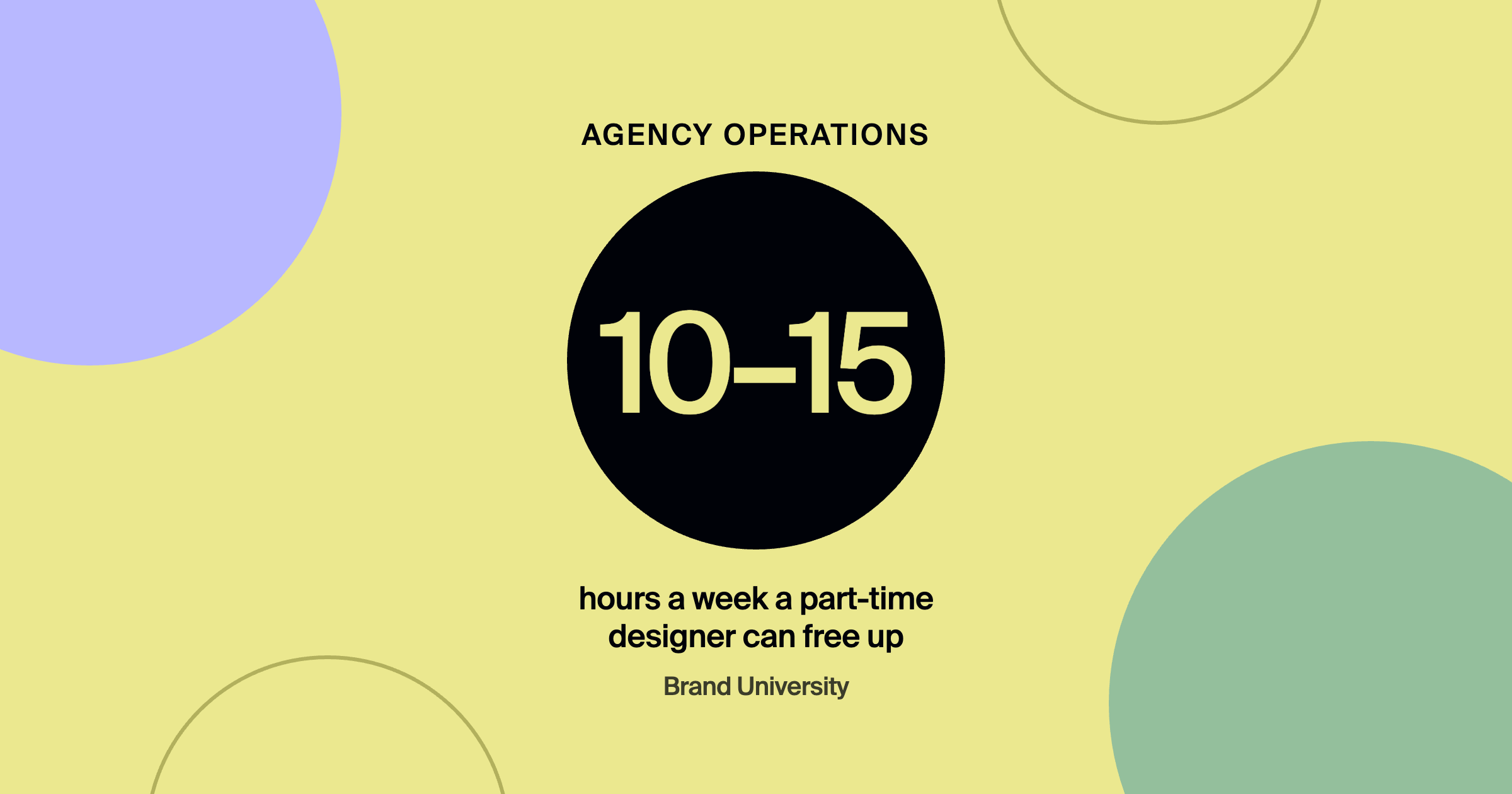
If your volume is consistent week over week, consider a dedicated remote designer. A part-time designer handling production work can free up 10 to 15 hours of your week at a fraction of what that time is worth at your billing rate.
How do you brief a freelancer so the work comes back right?
Bad outsourcing experiences almost always trace back to a bad brief, not a bad designer. A proper brief covers: what the project is and who it's for; brand context like the style guide, existing assets, and tone of voice; specific deliverables with exact specs, not a few social posts but 5 Instagram square posts at 1080x1080px using the existing brand colors and typography; reference work showing what you like and don't; file formats and delivery method; a timeline with first draft, revision, and final dates; and your revision policy.
The tighter the brief, the better the output. A great brief almost writes the work itself. If you use AI to speed up briefing and admin, branded by shares how its team does it in how agencies are using Claude AI to work smarter.
Does outsourcing actually save money?
Run the numbers. A designer billing $150 an hour who spends 8 hours a week on production work worth $25 an hour is giving up $1,000 a week in billable capacity. That's $52,000 a year. Outsource that work for $200 a week and you've freed roughly $4,000 a month in capacity for client work.
The math is clear once you see it. The hard part is letting go of control. That's an agency owner problem, and agency owners figure it out.
Frequently asked questions
Should freelancers who work for me sign contracts?
Yes. Use a written agreement covering scope, deadlines, payment, confidentiality, and ownership of the work.
Can outsourced designers talk directly to my clients?
Early on, it's usually better to keep client communication with you or a core team member for consistency.
Is a contractor or an employee better for ongoing help?
It depends on the work and your location's rules. See Hiring Your First Employee vs. Your First Contractor.
Where to go from here
Outsourcing isn't a last resort when you're drowning. It's a growth strategy you put in place before you need it. Start small, brief well, protect the client relationship, and expand capacity deliberately. The Creator Board and the Booklet of Operations are inside Brand University. Join Brand University on Skool to get access.
About the author
Evan Barnes is the founder of Brand University and of branded by, a brand-first growth agency based in Greenville, South Carolina. He built Brand University to teach designers the business side of design, from positioning and pricing to running client work, and more than 1,200 designers now learn inside the Brand University community on Skool.