The Designers Booklet of Operations: How to Run and Grow Your Agency Day-to-Day
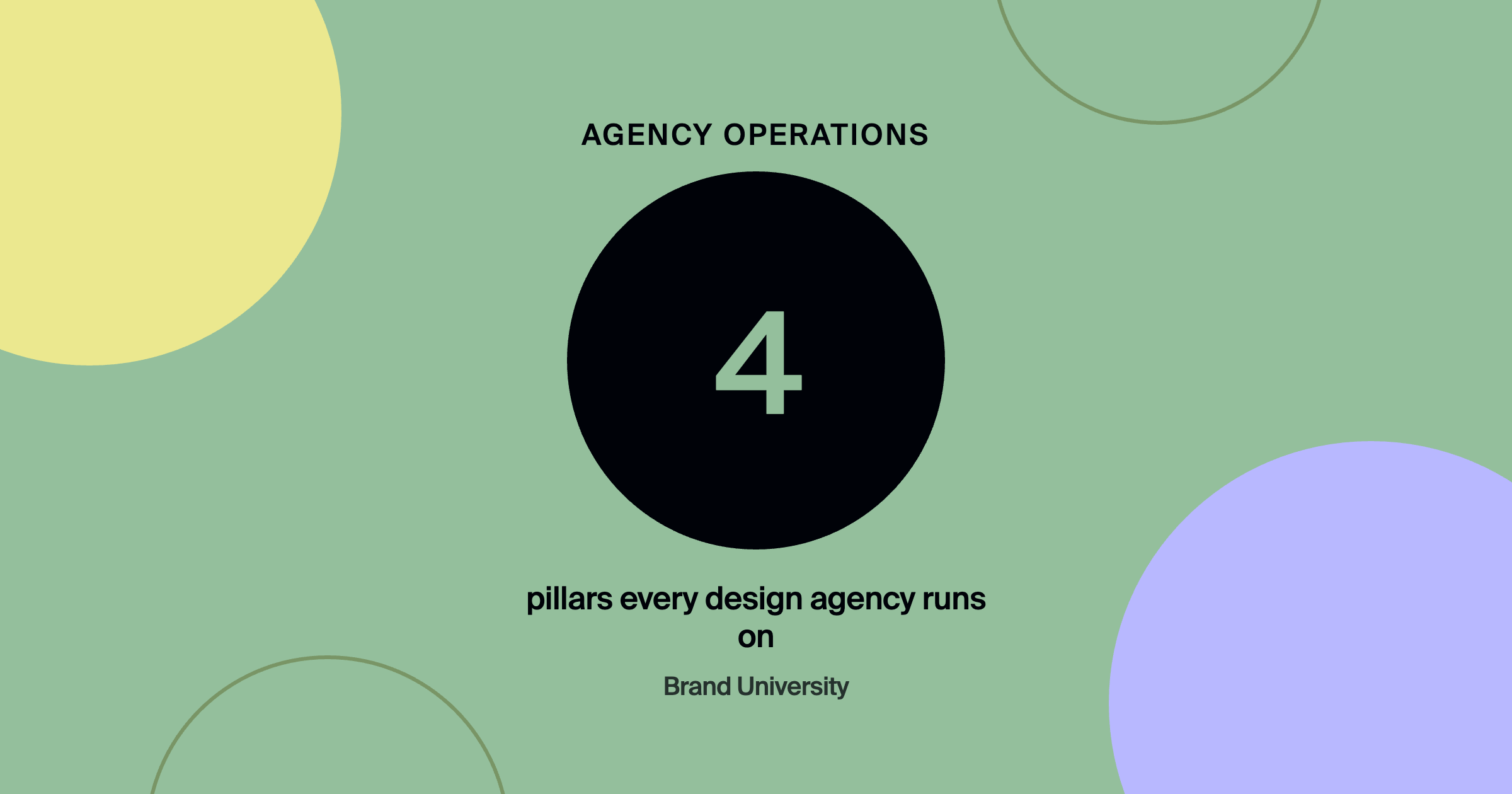


The short answer: a design agency runs on documented systems across four pillars: client acquisition and onboarding, project delivery, financial operations, and team or contractor management. Pair those documents with a simple weekly rhythm (plan Monday, deep work midweek, finances and pipeline Friday) and the business keeps running whether or not you're in the room.
Key takeaways
- Documentation, not headcount, separates agency owners from freelancers.
- Every pillar needs repeatable, written processes.
- Scope creep is an operations failure, not a client problem.
- Check your numbers weekly, not quarterly.
- Good operations create time instead of costing it.
What's the difference between a freelancer and an agency owner?
It's not headcount. It's not revenue. It's not even the clients you work with. It's documentation. A freelancer figures things out as they come up. An agency owner has a system for everything, and that system works whether or not they're in the room. That's the difference. And that's what lets you scale, delegate, take time off, and grow without grinding yourself into the floor.
Four pillars of agency operations
| Pillar | What gets documented |
|---|---|
| Client acquisition and onboarding | Lead qualification, discovery questions, proposal templates, a standard contract |
| Project delivery | Kickoff brief, milestones, feedback process, revision policy, delivery standards |
| Financial operations | Invoicing, payment terms, monthly expenses, profit per project |
| Team and contractor management | Contractor onboarding, brief templates, quality review, payment terms |
What are the four pillars of design agency operations?
Every well-run design agency operates across four areas. If any one of them is missing or chaotic, it creates drag that limits your growth.
1. Client acquisition and onboarding. This is the front door of your business. Everything from first contact to project kickoff needs to be documented and repeatable. How do you capture and qualify leads? What questions do you ask on the discovery call, and what do you need to leave with? Do you have proposal templates by service type, or are you building from scratch every time? Is your contract standardized? What does a new client need from you in the first 48 hours to feel confident they made the right call? If it's not documented, it's not a process. It's improvisation. The High Ticket Closer's Guide to Discovery Calls and Onboarding a New Client So the Project Starts Strong cover this pillar in depth.
2. Project delivery. Great creative doesn't matter if the delivery process is chaotic. Clients feel your operations even when they can't articulate it. A smooth delivery process is part of your brand. That means a standard project kickoff with a brief template and a list of what you need before you start. Clear milestones for concepts, revisions, and final delivery. A defined feedback process: written, video call, or annotated PDF. Pick one and hold the line. A revision policy set upfront. A consistent file organization system. And clear delivery standards so the client knows exactly what they're getting. Scope creep is an operations failure, not a client problem. Tight delivery systems prevent it. For web projects, branded by's 50-point website redesign checklist makes a strong pre-delivery QA standard.
3. Financial operations. Most creative people hate this part. Do it anyway. Agencies that don't track their financials consistently don't know if they're actually profitable, and many aren't, even when revenue looks healthy. Know your pricing structure. Know when you invoice and what your payment terms are. Track expenses monthly. Calculate profitability per project. Set a monthly revenue target, both minimum and goal. Know your numbers every week. A 15-minute Friday financial check-in keeps you from surprises. branded by's profitability equation is a useful framework for the numbers that matter.
4. Team and contractor management. The moment you start outsourcing, you need systems to manage the people you work with. This is where most designers underinvest, then blame contractors when things go wrong. You need a contractor onboarding process, standardized brief templates for every type of work you outsource, a quality review before anything goes to the client, clear communication norms, and defined payment terms. How to Outsource Like a Real Agency Owner covers briefing well.
What is the Booklet of Operations?
Inside Brand University, the Booklet of Operations is the master document that covers all of this: the systems, templates, and processes for running a 6-figure design agency day to day. It's not inspiration or frameworks. It's usable SOPs you drop into your business and adapt.
It covers the discovery call framework, proposal templates by service type, project delivery checklists for brand identity, UI/UX, web design, and motion, client communication scripts for feedback rounds and scope change conversations, file naming and delivery standards, financial tracking templates, and contractor brief templates and quality review processes. You don't need to build this from scratch.
What does a weekly rhythm for a design agency look like?
Operations aren't just documents. They're habits. Here's a simple weekly rhythm that keeps a design agency running without constant chaos.
- Monday: review active projects, check deadlines for the week, prioritize tasks, and send outstanding client follow-ups.
- Tuesday through Thursday: deep work. Client deliverables, creative work, execution. Protect this time. No admin that could be batched.
- Friday: 15-minute financial check-in. Invoice completed projects. Update your project tracker. Do one thing to move your pipeline forward: a cold email, a piece of content, or a follow-up call.
Simple. Repeatable. Sustainable. Not glamorous, but it's what keeps the business running and growing.
A simple weekly rhythm
| Day | The job |
|---|---|
| Monday | Review projects, check deadlines, prioritize, send follow-ups |
| Tuesday to Thursday | Protected deep work on client deliverables |
| Friday | 15-minute financial check-in, invoices, tracker, one pipeline move |
Why are operations worth the time?
Operations feel like overhead that takes time away from design. That's the wrong frame. Good operations make time. Every hour you spend documenting a process is an hour you get back every time that process runs. Every template is a shortcut you use forever. Every system removes a decision you'd otherwise make under pressure.
The designers who reach six figures consistently aren't always the most talented. They're the most organized. They treat their agency like a business, not a freelance gig with extra steps. Build the system. Run the system. Iterate as you grow.
Frequently asked questions
What systems does a small design agency need first?
Start with a discovery call framework, a proposal template, a standard contract, a project kickoff checklist, and a simple weekly financial check-in.
Where should agency SOPs live?
In one shared place the team already uses, like Notion or Google Docs. Claude + Notion for agency systems shows a setup.
How long does it take to document agency operations?
You can cover the essentials in a few focused sessions, then refine each process as you run it. Standard Operating Procedures: Where to Start helps prioritize.
Where to go from here
The full Booklet of Operations is inside Brand University. Join the Brand University community on Skool and start with the pillar that's causing you the most drag right now.
About the author
Evan Barnes is the founder of Brand University and of branded by, a brand-first growth agency based in Greenville, South Carolina. He built Brand University to teach designers the business side of design, from positioning and pricing to running client work, and more than 1,200 designers now learn inside the Brand University community on Skool.