How to Design a Logo When You Have No Ideas
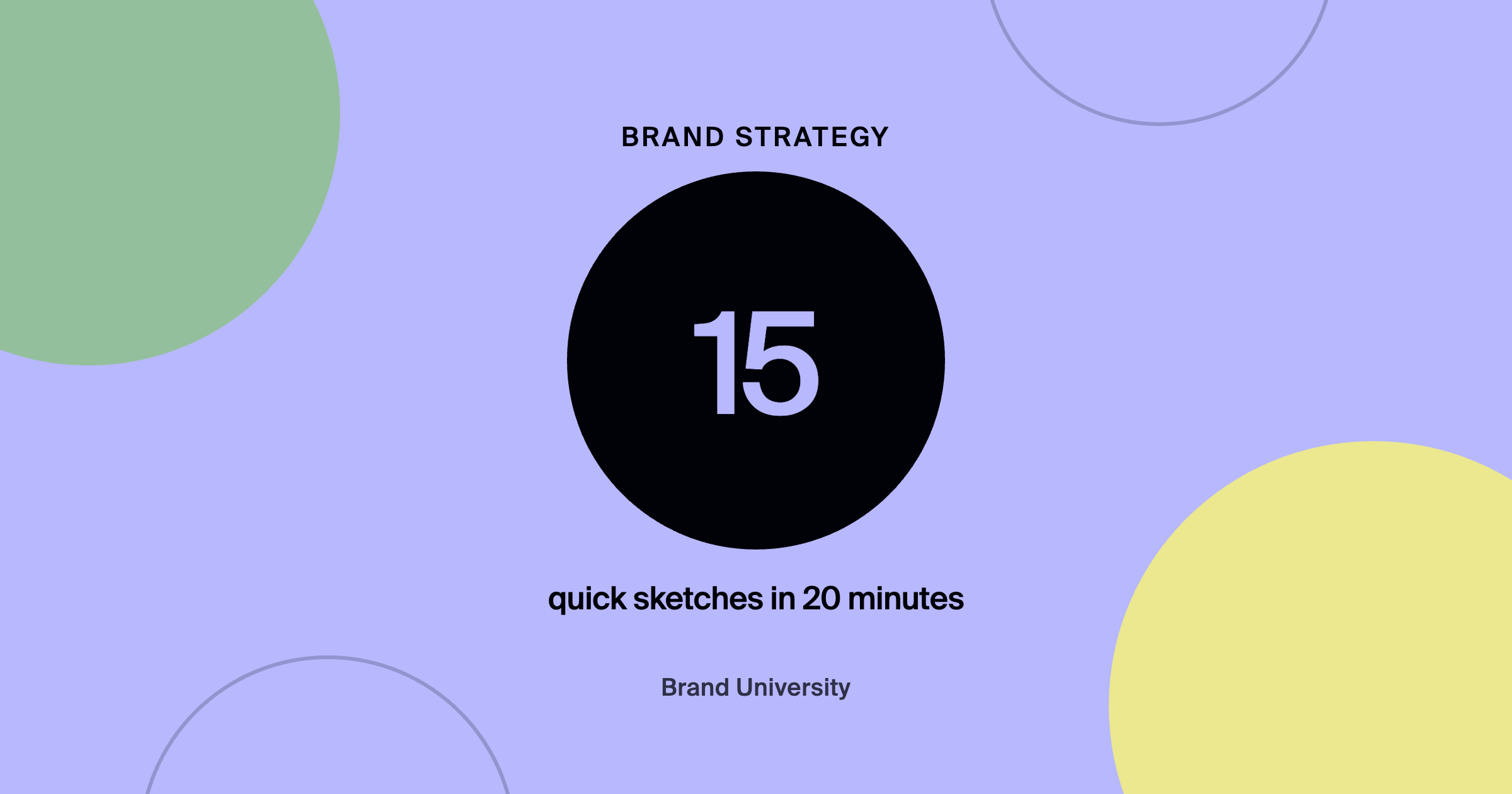


The short answer: don't start from a blank canvas. Write 15 to 20 words describing the business, study three reference logos for why they work, sketch 15 quick ideas on paper in 20 minutes, build your strongest sketch three ways (wordmark, symbol plus wordmark, symbol alone), then test each at favicon size and in solid black.
Every designer has sat in front of a blank canvas with a brand brief open in another tab and nothing happening. That blank moment isn't a talent problem. It's a process problem. Designers who never seem to run out of ideas aren't more creative than you. They just never start from a blank canvas. They start from a sequence.
Key takeaways
- Words come before sketches.
- Study why a logo works, not what it looks like.
- The first five ideas are everyone's ideas. Burn through them.
- Build one concept in three formats before choosing.
- A strong mark survives favicon size and solid black.
- Write before you draw15 to 20 words describing the business, including what it isn't.
- Study three referencesReverse engineer why they work, not what they look like.
- Sketch fifteen ideasOn paper, in under twenty minutes. Burn through the obvious ones.
- Build one direction three waysWordmark, symbol plus wordmark, and symbol alone.
- Test it small and in blackA strong mark survives favicon size and solid black.
Step 1: Why write before you draw?
Open a blank document, not a blank canvas, and write down every word that describes the business. Not design words. Business words. What do they actually do. Who do they do it for. What do they want a customer to feel in the first five seconds. What are they not.
That last one matters more than people think. A logo for a business that explicitly isn't stuffy, isn't corporate, isn't trying to look bigger than it is, points you somewhere completely different than one with no boundaries at all. You're not ready to open a design tool until you have fifteen or twenty words on that page.
Step 2: How do you use reference logos without copying?
Pick three logos, from any industry, that get at the same feeling your words describe. Not logos that look similar. Logos that feel similar. A feeling of speed can come from a typeface as easily as an icon. A feeling of trust can come from symmetry as easily as a color.
Look at what's actually doing the work in each one. Is it the negative space. The weight of the line. The fact that it's just type, confidently set, with nothing else competing. You're not copying these marks. You're reverse engineering why they work, so you know what lever to pull for your own brief. branded by's breakdown of pickleball's branding boom is a good example of an entire category building distinct identities from the same short list of shapes and colors.
Step 3: Why sketch fifteen bad ideas first?
Fifteen, on paper, in under twenty minutes. Most will be bad. That's the point. The first five ideas anyone has are the same five ideas everyone has, the obvious ones. You have to burn through those to get to the interesting ones. Set a timer. Don't judge while you draw. Judge after.
When the timer's up, circle the three that make you want to see them finished. Not the three that are technically correct. The three that pull at something.
Step 4: Why build one direction three ways?
Take your strongest sketch into your design tool and build it as a wordmark, as a symbol plus wordmark, and as an abstract mark alone. This isn't about picking a winner yet. It's about seeing which format actually carries the idea. Some concepts only work with the icon attached. Some are strong enough to stand as type alone. For how this scales into naming, positioning, and guidelines on a real project, see how branded by rebrands a manufacturing company in eight stages.
Step 5: How do you test a logo concept?
Shrink every version down to the size of a favicon. Whatever survives that test survives real use, on an app icon, a social avatar, a business card. Whatever disappears or turns to mud at that size needs to be simplified, not saved with more detail.
Then strip the color entirely. A strong mark works in solid black. If a logo only works because of a gradient or a clever color pairing, the structure underneath isn't finished yet. Fix the structure first. Color is the last five percent, not the first.
Is more inspiration the fix for creative block?
No. Designers who get stuck reach for another mood board, another hour on Pinterest. That's backwards. Inspiration doesn't create ideas. Constraints do. Follow the five steps in order and the blank canvas problem mostly disappears, because you're never starting from blank. You're starting from fifteen words, three references, and fifteen sketches, and picking from what's already there.
No ideas usually means no clear position to design from. The free positioning statement builder turns what you do, who you do it for, and the result into a statement, a portfolio headline and a LinkedIn headline you can paste today.
Frequently asked questions
How long should it take to design a logo concept?
With this sequence, a first real concept can come together in about two hours. Refinement and client rounds take longer.
Should I sketch logos on paper or digitally?
Paper first. It's faster, less precious, and makes it easier to generate lots of rough ideas.
How many logo concepts should I show a client?
One strong, well-reasoned direction tied to the strategy often lands better than several weaker options.
Where to go from here
This process, and the full identity workflow from concept to client-ready delivery, is taught inside Brand University. Once the mark is locked, see How Many Logo Variations Does a Client Really Need and Why Most Designers Are Undercharging. Join Brand University free on Skool and start with the logo design course.
About the author
Evan Barnes is the founder of Brand University and of branded by, a brand-first growth agency based in Greenville, South Carolina. He built Brand University to teach designers the business side of design, from positioning and pricing to running client work, and more than 1,200 designers now learn inside the Brand University community on Skool.