The Discount Trap: Why Cutting Your Price Never Wins the Deal


The short answer: discounting feels like it saves a deal, but it tells the client your first number wasn't real, lowers the anchor for every future project, cuts your margin, and rarely earns the loyalty you hoped for. Offer less scope, phased work, or payment terms instead.
Cutting your price feels like the move that closes the deal. Usually it's the move that loses your leverage, your margin, and some of the client's respect all at once.
Key takeaways
- A discount signals your price was negotiable from the start.
- Discounted prices become the new baseline.
- Margin lost on discounts is hard to recover.
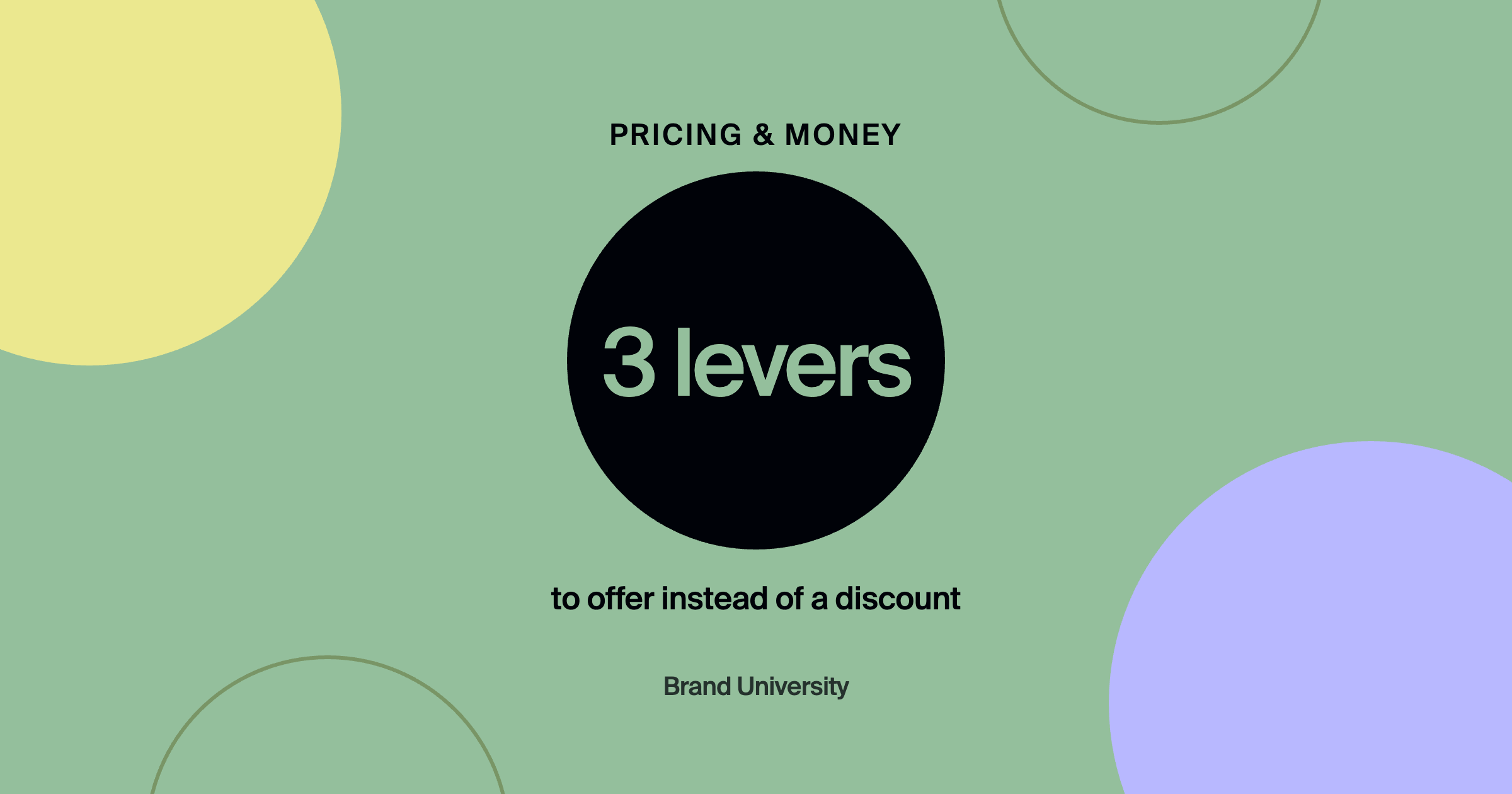
- Scope, phasing, and payment terms are better levers.
- Confident pricing builds trust.
Why doesn't discounting work for designers?
Because it answers the wrong question. Most price objections come from uncertainty about value, not an actual budget ceiling. Dropping the price doesn't resolve uncertainty. It confirms the original number was inflated. Handling the Can You Do It Cheaper Objection addresses the real concern.
How does a discount affect future projects?
It becomes the anchor. The next project, the referral, and the retainer all start from the discounted number. Raising it later is far harder than holding it now.
How much does discounting cost you?
More than it looks. Because costs stay the same, a 20 percent discount can remove a much larger share of profit. branded by's profitability equation helps show how quickly thin margins compound.
What can you offer instead of a discount?
Less scope at the same rate, phased work so the client can fund it over time, or adjusted payment terms that help cash flow without changing the price. Negotiating Scope Without Negotiating Price covers each option.
A discount
- Signals your first number wasn't real
- Becomes the anchor for future work
- Cuts margin you rarely recover
Offer instead
- Less scope at the same rate
- Phased work funded over time
- Adjusted payment terms
Is there ever a good reason to discount?
Occasionally, as a deliberate strategic choice, like entering a new niche with a portfolio piece or a nonprofit you want to support. Make it explicit and one-time, never a reflex.
The best defense against discounting is knowing what the price should be in the first place. The free design pricing calculator gives you a price to quote for any project type based on your experience, the client, and what you need to earn this year. No email required.
Frequently asked questions
Should I offer early-payment discounts?
Some designers do for paying in full upfront. It's a cash flow trade, not a price cut, and can work if you set it deliberately.
What about discounts for repeat clients?
Loyalty perks like priority scheduling usually work better than cutting price.
How do I say no to a discount request?
Keep your rate and offer options: I keep pricing consistent, but here's a smaller version that fits your budget.
Where to go from here
Pricing confidence is covered inside Brand University. Pair this with Value-Based Pricing, and join Brand University on Skool.
About the author
Evan Barnes is the founder of Brand University and of branded by, a brand-first growth agency based in Greenville, South Carolina. He built Brand University to teach designers the business side of design, from positioning and pricing to running client work, and more than 1,200 designers now learn inside the Brand University community on Skool.