Avoiding Burnout When You're the Whole Agency


The short answer: watch for early warning signs like dreading routine emails, block uninterrupted time for creative work and batch admin separately, decide in advance when your workday ends, and start delegating small repeatable tasks before you're overwhelmed. Burnout in a one-person agency is a scheduling problem as much as a workload problem.
Being the designer, salesperson, accountant, and support line, often in the same afternoon, makes burnout close to inevitable unless something changes. The good news is that most of the fixes are structural.
Key takeaways
- Catch the early signs before they compound.
- Context switching is exhausting. Batch similar work.
- Define what done for today means, and honor it.
- Delegate before you're desperate, not after.
- Burnout is a signal to change the business, not push harder.
What are the early signs of burnout for designers?
Dreading client emails that used to feel routine, resenting work you used to enjoy, slipping quality, procrastinating on creative work, and never feeling off the clock. These are signals, not personal failings. Catching them early gives you far more room to adjust.
How do you protect creative time as a solo designer?
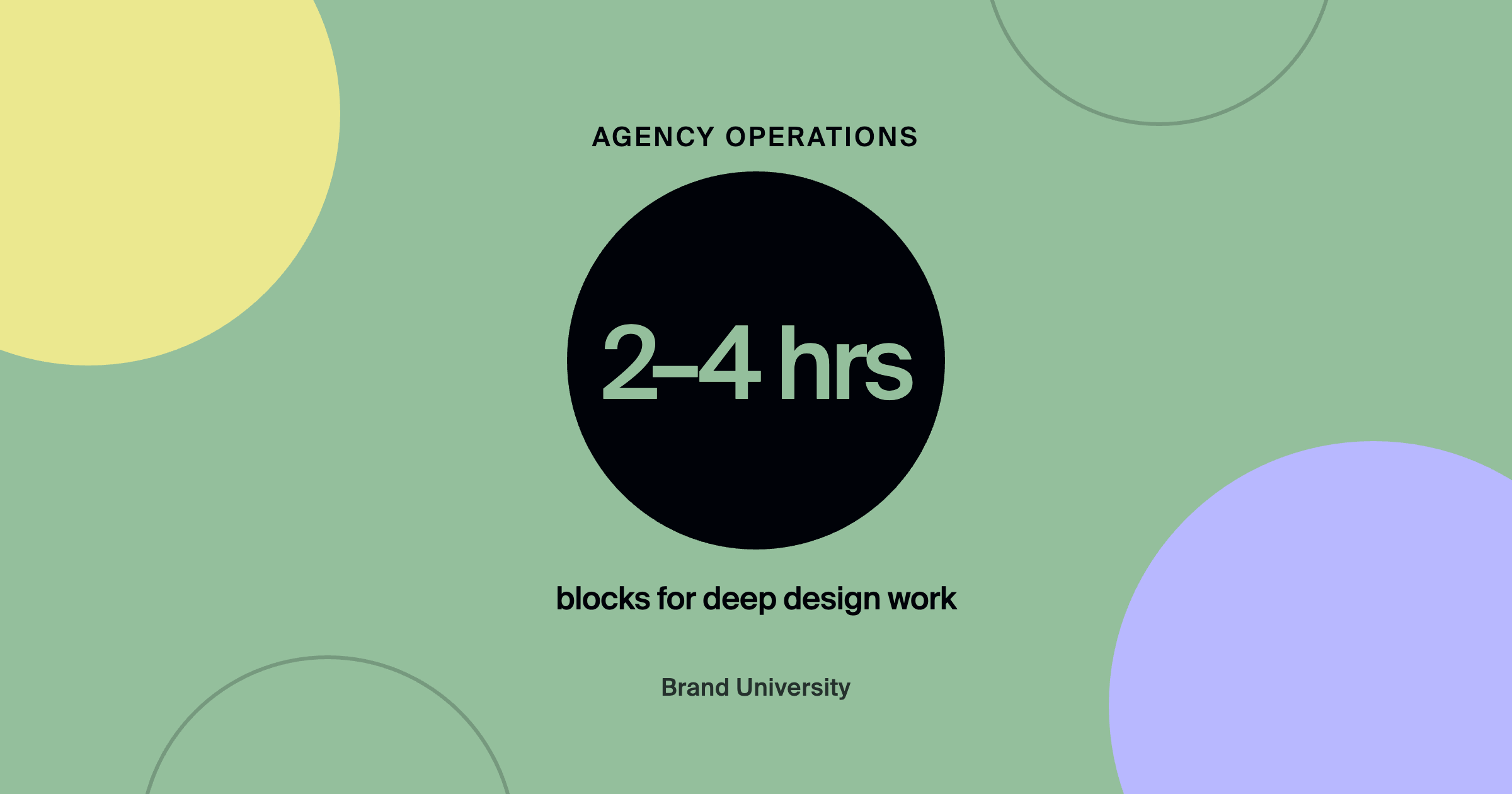
Block it on your calendar like a client meeting. Keep deep design work in two to four hour blocks, and batch email, invoicing, and calls into separate windows. Constant switching between creative and admin work drains more energy than either one alone.
How do you stop working all the time?
Decide what done for today looks like before the day starts, and stop when you hit it. Without a defined end, there's always one more email. Set clear communication hours with clients too. Setting Work-Life Boundaries When Clients Text at 9pm covers how.
When should a solo designer start delegating?
Before it's urgent. Delegating in crisis mode rarely goes well. Start with small, repeatable tasks like scheduling, invoicing, file prep, or social scheduling. AI tools can take some of this load too. branded by describes how its team uses them in how agencies are using Claude AI to work smarter. What to Delegate First helps you choose.
- Watch the early signsDreading routine emails, slipping quality, never feeling off the clock.
- Block deep workTwo to four hour blocks for design, admin batched separately.
- Define done before the day startsAnd stop when you hit it.
- Delegate small tasks earlyBefore it's urgent: scheduling, invoicing, file prep.
What if the business is taking away the freedom you started it for?
Treat it as a real signal. Most people start a design business for more freedom and creative control. If it's consuming both, that's a reason to change pricing, scope, clients, or structure, not just push through.
Frequently asked questions
How many hours a week should a freelance designer work?
There's no universal answer, but consistently working far beyond what you can sustain is a sign pricing or scope needs to change.
Can raising prices help with burnout?
Often, yes. Higher prices mean fewer projects for the same income, which frees time and energy.
Should I take time off as a solo designer?
Yes. Schedule it in advance, tell clients early, and set up an out-of-office plan.
Where to go from here
Sustainable business practices are covered inside Brand University. Pair this with Systemizing Delivery So Quality Doesn't Depend on You, and join Brand University on Skool.
About the author
Evan Barnes is the founder of Brand University and of branded by, a brand-first growth agency based in Greenville, South Carolina. He built Brand University to teach designers the business side of design, from positioning and pricing to running client work, and more than 1,200 designers now learn inside the Brand University community on Skool.